

It’s easy to procrastinate and put off doing tasks, especially if they’re difficult, complicated or boring. It is natural to gravitate towards the easier quicker tasks.
The problem with procrastination is that new tasks will soon pile up into a mountain. This applies both at work and at home. The more we procrastinate, the more irritated, frustrated, stressed and anxious we become. But don’t panic, there is a solution… you can learn how to make the mountains seem much easier to climb.
Turn big tasks into mini projects
Every day our brain tricks us into doing the easiest tasks first. However, you can fool your brain by thinking of large tasks as a series of mini-projects, this will allow you to get on with the tough tasks without being intimidated. This will help you procrastinate less.
Take it step by step
I don’t mean to downplay demanding tasks, our resistance threshold to undertaking tasks that require more energy (and are more challenging) can feel high. Dividing tasks into smaller parts, lowers the resistance and helps us get started faster. By taking one step at a time, it feels like a small easy task.
To trick your brain, you’ll need to plan how to manage larger tasks as if they were mini projects. This can be difficult in the first instance but it will get easier.
Here are four steps to help you turn a large task into a mini project:
1. Set a target date for when the task would be completed
2. List all activities needed to complete the task
3. Estimated the time required for each activity
4. Schedule time in your calendar when you will work on the tasks
Set goals, plan and schedule
The more you think about what needs to be done, how it should be done and when you can do each part, the greater the chance that you will succeed. Tasks become easier by setting goals, planning and structure, which can have a significant effect on both your efficiency and performance.

Here are two examples of how to stop procrastinate. One from work (Juan) and one from home (Anne).
Example: Juan at work
Juan promised his boss that he would deliver a report on time but after the deadline he still hadn’t started. Juan viewed the report as a large and difficult task which caused him to procrastinate and put off starting several times. The boss gave him a 5-day extension but Juan still didn’t know how he could catch up and deliver the report without his normal working hours.

How Juan can manage the project better
Juan can make the task easier for himself by turning it into a series of mini projects. That is, to divide the report into manageable smaller tasks. By breaking the task down each smaller part becomes less time consuming and thus easier to implement, both mentally and practically.
When a large task with multiple parts needs to be completed, it’s important to write and follow a plan.
Here are some tips on how Juan can plan this project:
• Create a list of all small tasks that need to be done to finish the report.
• Review each task and estimate how much time will need to be allocated for each element.
• Allocate completion dates for each section of the report.
• Block out time in the calendar when the work will be done.
Results of Juan’s planning
When Juan divides the report into small tasks, set deadlines and blocks the time to work on them in his calendar, the overall task feels much easier to complete. He realises that he will have time to finish the report without working as much overtime as he first feared.
As a result, Juan feels both calmer and happier because he knows that he will successfully complete the report on time. The next time he gets tricky tasks, he knows that it will be beneficial to manage them as mini projects, so he doesn’t miss important deadlines.
Example: Anne at home
Anne really thinks it’s high time for a deep clean at home but has been procrastinating and putting it off for far too long. The task feels heavy, boring and hard to even think about it. When the sun shines into the living room she sees the grimy windows, dusty paintings and the place just feels dirty. Anne sighs and wonders when and how she will get enough energy to do this huge cleaning job.

How Anne can make her cleaning task easier and more fun
Anne has a family, a husband and two children aged 9 and 12 years, who also live in the house. So, she can split the cleaning into mini-projects for the whole family. By splitting the tasks, it will get done faster and will be more fun.
Here are the steps that Anne can take to split the cleaning in to mini-projects:
• Figure out how to involve the family and make them part of the project.
• Update the family: Gather them together to tell them that the house needs upgraded and that it can be done for no cost and it will be fun, if they all help.
• Invite ideas: When they have agreed to be part of the project, hold a meeting to allow everyone to present their ideas for improvements.
• Allocate tasks: Now it has been decided what needs to be done, each person needs to agree to handle a task, but it must be fair depending on each person’s available time.
• Set deadlines together: When all tasks have been allocated, the next step is to decide when everything should be finished (and note it in the calendar) and then everyone will be responsible for delivering on time. Then decide how you will celebrate when the project is finished, a trip to a local funfair or your favourite cake.
• Troubleshooting: If the project continues over several weeks, it may be a good idea to have a few meetings to address any ‘problems’ along the way.

Results of Anne’s planning
When the entire household becomes involved in a major task, it increases everyone’s awareness of just how much work is involved in a major house clean.
Hopefully, the more aware they are, the better they will keep the house clean and tidy in the future. Or it could be suggested that the activity will be repeated, for example every three months. Together you can decide which dates should be set for this project.
More choice = more motivation
It is important that everyone is encouraged to say what they want to do and then decide for themselves when to do it, if the deadline is to be kept. When people can choose what and how they want to do something, the more motivated they will become and the more responsibility they will feel for completing their share of the project.

How to plan larger tasks
In summary, here are the golden rules for planning larger tasks. When writing down your plan, choose the method that works best for you, by hand or online, it doesn’t matter as long as you make sure your plans are visible. Otherwise they can be easily forgotten or ignored!
• Write what your end goal is and when it has to be ready or when you want it to be ready (depending if it’s your own wish or a must at work)
• Write down each task you need to do to reach your goal (get more info, meetings, help from others)
• Try to estimate how long time each task will take and write that down
• Set a date for when each activity should be performed
• Book suitable times for when you will do the activities in your calendar
If for any reason you need to do something else during your designated time, make sure you rebook your project at the next available time. Then you can still achieve your goals and hit the deadline, whilst being flexible at the same time.
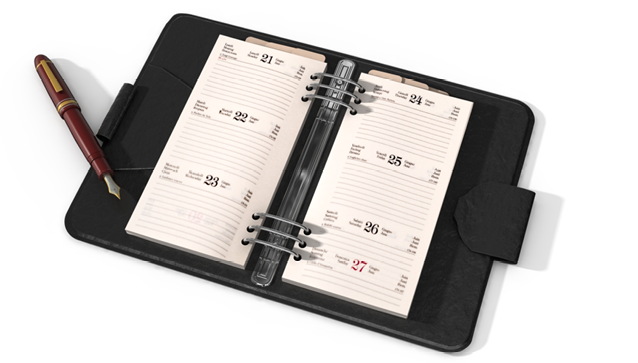
Why it is important to book your own appointments in your calendar
When you book a meeting in your calendar, you make it visible. This increases the chance that you will prioritise this activity. You will automatically be reluctant to move to move your own meeting.
If you need to move your meeting to a more suitable time, it doesn’t matter. The important thing is that it is still booked and visible. When something is made visible, it becomes easier to prioritise and there is a greater chance that it will be done – during normal working hours.
Always check your calendar
A visible booking in your calendar also makes it easier to say no to spontaneous requests. So, make it a habit to always check your calendar when someone asks if you have time. Then you can see the time you have booked at a glance and suggest a time that suits you better.
If you don’t block time out for important tasks in your calendar it looks as if you have free time. Then there is a greater risk that you will agree to a meeting even though you cannot spare the time. This can mean you will need to work on your mini projects out of regular office hours.
By Ulla Lilliehook Trainer and Personal Growth Coach, JOHALOHA.COM